Showing posts with label COMPUTER SYSTEM SOFTWARE. Show all posts

Wednesday, 4 January 2017

VIRTUALIZATION OF OPERATING SYSTEM

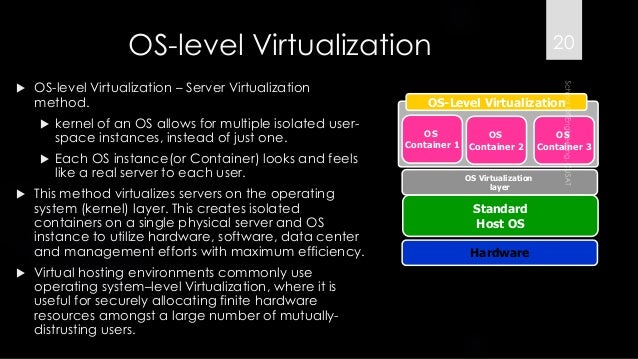
Operating system virtualization refers to the use of software to allow system hardware to run multiple instances of different operating systems concurrently, allowing you to run different applications requiring different operating systems on one computer system. The operating systems do not interfere with each other or the various applications. Not to be confused with operating system-level virtualization, which is a type of server virtualization.

 VIRTUALIZATION OPERATION ENVIRONMENT


Click here to learn more about virtualization

Tuesday, 3 January 2017

DOS OPERATION

Microsoft Disk Operating System, MS-DOS is a non-graphical command line operating system derived from 86-DOS that was created for IBM compatible computers. MS-DOS originally written by Tim Paterson and introduced by Microsoft in August 1981 and was last updated in 1994 when MS-DOS 6.22 was released. MS-DOS allows the user to navigate, open, and otherwise manipulate files on their computer from a command line instead of a GUI like Windows.
 DOS ENVIRONMENT

FUNCTION OF OPERATING SYSTEM

There are Many Functions those are Performed by the Operating System But the Main Goal of Operating System is to Provide the Interface between the user and the hardware Means Provides the Interface for Working on the System by the user. The various Functions those are Performed by the Operating System are as Explained below...Click here to learn more function of operating system

COMPILER, INTERPRETER, LINKER, LOADER

Compiler: It is a program which translates a high level language program into a machine language program. A compiler is more intelligent than an assembler. It checks all kinds of limits, ranges, errors etc. But its program run time is more and occupies a larger part of the memory. It has slow speed. Because a compiler goes through the entire program and then translates the entire program into machine codes.
Interpreter: An interpreter is a program which translates statements of a program into machine code. It translates only one statement of the program at a time. It reads only one statement of program, translates it and executes it. Then it reads the next statement of the program again translates it and executes it. In this way it proceeds further till all the statements are translated and executed. On the other hand, a compiler goes through the entire program and then translates the entire program into machine codes. A compiler is 5 to 25 times faster than an interpreter.

UTILITY SOFTWARE

Utility Programs

Programs used to merge and sort sets of data, keep track of computer jobs being run, compress files of data before they are stored or transmitted over a network, check for viruses, and perform other important tasks.
Click here to learn utility Soft ware

Monday, 2 January 2017

TYPES OF OPERATING SYSTEMS

Operating systems are there from the very first computer generation and they keep evolving with time. In this chapter, we will discuss some of the important types of operating systems which are most commonly used.

Batch operating system

The users of a batch operating system do not interact with the computer directly. Each user prepares his job on an off-line device like punch cards and submits it to the computer operator. To speed up processing, jobs with similar needs are batched together and run as a group. The programmers leave their programs with the operator and the operator then sorts the programs with similar requirements into batches.

The problems with Batch Systems are as follows −
  • Lack of interaction between the user and the job.
  • CPU is often idle, because the speed of the mechanical I/O devices is slower than the CPU.
  • Difficult to provide the desired priority.

OPERATING SYSTEM CONCEPT

An Operating System OS is an interface between a computer user and computer hardware. An operating system is a software which performs all the basic tasks like file management, memory management, process management, handling input and output, and controlling peripheral devices such as disk drives and printers.
Some popular Operating Systems include Linux, Windows, OS X, VMS, OS/400, AIX, z/OS, etc.

Definition

An operating system is a program that acts as an interface between the user and the computer hardware and controls the execution of all kinds of programs.
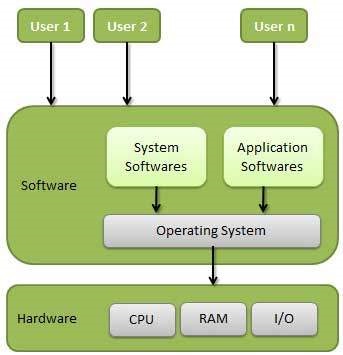
Conceptual view of an Operating System